What is the Current Status of Official Lot Release in Rwanda?
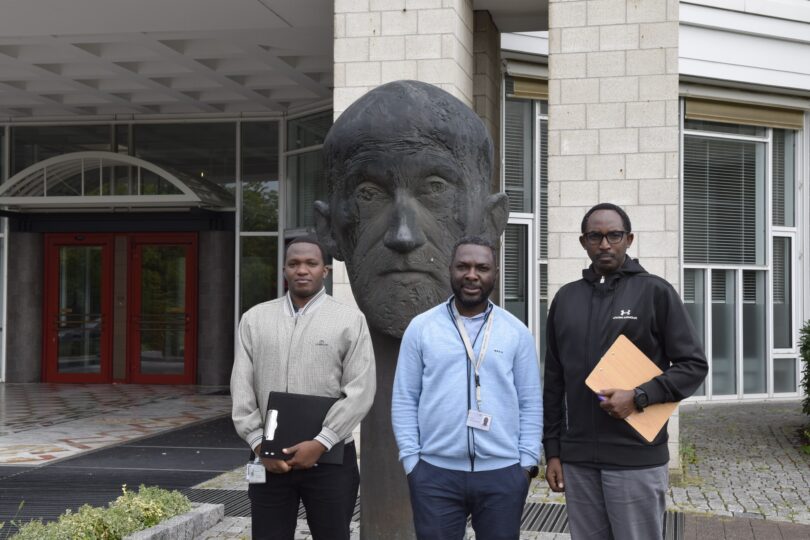
Two experts from Rwanda Food and Drugs Authority explain the country’s current official lot release status. In doing so, they share what they learnt most during their seven-week training course at the Paul-Ehrlich-Institut.

Great efforts are being made to increase vaccine production in Africa. Local drug regulatory authorities are responsible for testing vaccine batches for quality, safety, and efficacy. They approve them for human use. The VaccRelease project of the Paul-Ehrlich-Institut (PEI) supports its partner countries in Africa in setting up an effective official lot release (LR) system.
Currently, the Rwanda Food and Drugs Authority (FDA) is establishing its own laboratory for lot release. In addition to various preparatory training courses, two intensive seven-week hands-on training programs were held for a total of four employees from Rwanda FDA at PEI. They learnt about various methods of vaccine testing, carried them out under the guidance of PEI staff, and obtained qualification after successfully completing several testing methods. The fact that some of these test procedures can otherwise be carried out by only one other African control laboratory highlights the significance of this qualification for the African continent.
The following article provides insights into the collaboration with the Rwandan regulatory authority, the Rwanda FDA. It features interviews with Dr Peter Rwibasira, Head of the Department for Vaccines and Biological Medicinal Products, and Jean Claude Tomani, Analyst for Vaccines and Biological Medicinal Products at the Rwanda FDA.

VaccRelease: What measures is the Rwanda FDA already taking in the context of lot release? Which vaccines and methods are currently being tested and evaluated?
Dr Rwibasira: Rwanda FDA has established a Vaccines & Biologics Testing Division that will coordinate and conduct testing for lot release of vaccines and other concerned biological products. All vaccines will be released on the market via various internationally accepted lot release pathways – including but not limited to standard testing procedures, review of lot summary protocols from manufacturers, or reliance on LR certificates from other NRAs [National Regulatory Agencies; NRA] or OMCLs [Official Medicines Control Laboratories; OMCL].
VaccRelease: You both and two colleagues took part in a seven-week training course at the PEI, mainly based in the laboratories. What was the purpose of the training? How can it support lot release at the Rwanda FDA?
Dr Rwibasira: This seven-week training held at PEI was designed to build technical skills in vaccine testing and lot release procedures, primarily through hands-on laboratory experience. This training will enable the Rwanda FDA to apply international standards and advanced analytical methods locally, ensuring robust quality assurance for vaccine batches before they enter national or regional markets.
Mr Tomani: In addition, Rwanda FDA has recently reached WHO Maturity Level 3 [ML3] for the regulation of medicines and vaccines – non-producing – and the Authority looks forward to attaining Maturity Level 3-vaccine producing status. As a country that produces vaccines, the NRA is responsible for the general oversight, which is precisely why a reliable lot release is required. This training helps to address gaps in skills and building the necessary capacity for the lot release process, leading to improved efficiency.

VaccRelease: As a supplement: WHO maturity level 3 stands for a stable, well-functioning, and integrated regulatory system, and with Rwanda, there are now eight countries on the continent that have achieved this. [1] What was your most important takeaway from the training?
Dr Rwibasira: The trained staff gained deeper understanding of regulatory procedures, documentation, and the rationale for each method. It leads to more confident and competent decision-making in upcoming lot release activities. Another key takeaway message was mastering advanced laboratory techniques for lot release, which are typically only performed in a limited number of African control laboratories.
Mr Tomani: For example, this includes test procedures for mRNA vaccines [messenger-RNA; mRNA], which are, of course, a new procedure for us. It also includes the potency testing of DTaP [Diphtheria, Tetanus, acellular Pertussis; DTaP], a combined vaccine against diphtheria, tetanus and pertussis, which is highly relevant to public health. During the training, we also qualified in the efficacy testing of vaccines against Haemophilus influenzae type b [Hib].

VaccRelease: How do you ensure that the knowledge you have acquired is quickly applied within the authority?
Dr Rwibasira: Rwanda FDA emphasises continuous professional development and regularly reviews staff proficiency to maintain high standards. The knowledge acquired during this training will be integrated by updating internal protocols, implementing new standard operating procedures, and conducting skill transfer sessions among colleagues within the authority.
VaccRelease: Are there any particular challenges regarding knowledge transfer or implementation within the authority? If so, how are you dealing with them locally?
Dr Rwibasira: Key challenges include adapting the LR system established at PEI to the local context, given the limited laboratory and human resources capacities at Rwanda FDA. Potential solutions include establishing the regulatory system based on the local context and fostering continuous collaborations for knowledge transfer and learning from different stakeholders and partners.
VaccRelease: What are the Rwanda FDA’s plans for the coming years? How can the VaccRelease project support this?
Dr Rwibasira: As mentioned above, Rwanda FDA plans to upgrade its current status from WHO Maturity Level 3 non-producing to ML 3&4 vaccines and drugs producing, through establishing a robust lot release function. The VaccRelease project can support this through providing continuous capacity building activities, technical assistance, and networking opportunities, which will help the Rwanda FDA to become a regional hub for vaccine lot release and support the broader goal of increasing African vaccine production and regulatory self-reliance.
[1] WHO news. (5 Dec 2024). Senegal and Rwanda achieve WHO Maturity Level 3 in medicines regulation. Available at: https://www.who.int/news/item/05-12-2024-senegal-and-rwanda-achieve-who-maturity-level-3-in-medicines-regulation (Accessed: 15 January 2026).