AfroLabNet3
Improving Pandemic Preparedness and Outbreak Response in the Global South by Reinforcing Laboratory Networks and Mobile Response Capacities.
Context
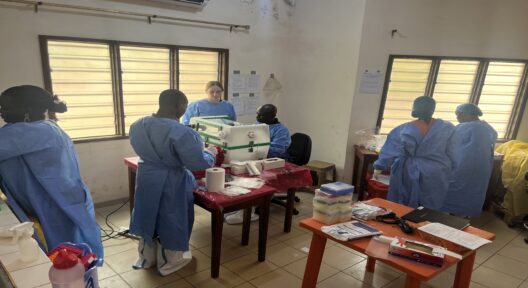
New and re-emerging infectious diseases pose an ongoing risk to public health. Political instability, climate change, and environmental degradation increase the risk of outbreaks, such as viral haemorrhagic fever. Many countries south of the Sahara, where dangerous pathogens are endemic, have limited resources, inadequate infrastructure, and insufficient capacity to counteract them. Stationary and mobile laboratory units are an important tool in responding to such disease outbreaks. This project aims to further reinforce laboratory preparedness and response mechanisms for viral hemorrhagic fevers (VHFs) and other emerging infectious diseases in the Global South. It focuses on strengthening regional laboratory networks in high-risk areas to ensure rapid and effective outbreak management, expanding diagnostic capabilities to support patient care, and maintaining the readiness of mobile lab deployments in both the Global South and Europe. Adopting a One Health approach, the project investigates the interplay between humans and zoonotic virus reservoirs to support early detection and more effective prevention. Through these strategies, the project achieves short-term improvements in outbreak response while at the same time establishing sustainable structures and capacities for future public health emergencies. The project builds on the successes of AfroLabNet and AfroLabNet2.0. Since 2016, both of these predecessor projects have been working to maintain and expand stationary and mobile laboratory capacities for the detection of VHFs and emerging viral diseases.
Objective
Improved management of outbreaks of high-risk pathogens in participating countries of the Global South through targeted strengthening of national and regional health systems
In Cooperation with
- Irrua Specialist Teaching Hospital (ISTH), Irrua, Edo State, Nigeria
- Laboratoire des Fièvres Hémorragiques Virales de Cotonou, Benin
- Centre d’Information de Prospectives et de Conseils sur les IST/VIH/Sida, Parakou, Benin
- Laboratoire des Fièvres Hémorragiques Virales de Guinée (LFHVG), Matoto, Conakry, Guinea
- Laboratoire des Fièvres Hémorragiques Virales de Gueckédou (LFHV-GKD), Guinea
- Laboratoire des Fièvres Hémorragiques Virales de l’hôpital regional de N’Zérékoré (HRNZE)), Guinea
- Njala University (NU), Department of Environmental Health Sciences, School of Community Health Sciences, Njala Campus Bo, Sierra Leone
- Federal Medical Centre (FMCO), Owo, Ondo State, Nigeria
- Robert Koch-Institut, Berlin, Germany
Thematic priorities
Facts
Activities
-

Research and provision of evidence
From Conceptual to Operational One Health: This project embeds a field-based One Health approach, taking into consideration the impact of animal reservoirs and vectors on human health. This enables real-time investigations of zoonotic spillover events and provides improved early warning for diseases with pandemic potential.
-
Networking and cooperation
From Maintenance to Regional Readiness: This project emphasises regional interoperability and coordinated outbreak response, particularly through the expansion of mobile laboratory networks and cross-border surveillance systems.
-
Capacity building
From Infrastructure to Integration: The project strengthens the interface between diagnostics, surveillance, and clinical management. This enables labs to contribute directly to case management, data analysis, and rapid public health action.
-
Training and competence development
From Training to Sustainable Multidisciplinary Workforce Development: This project strengthens sustainable human resource capacity through structured, curriculum-based mentorship programs. It connects multiple response types, aligns with national systems, and leverages regional training-of-trainers models.