AMR-EFFECT
Advancing an effective RKI international support strategy for sustainable implementation of global antimicrobial resistance (AMR) commitments
Context
Antimicrobial resistance (AMR) is one of the leading causes of death worldwide: in 2019, approximately 4.95 million deaths were attributable to infections with resistant bacteria. AMR-EFFECT builds directly on its GHPP-predecessor project, WHOCC-AMR, addressing the global challenges of AMR and healthcare-associated infections (HAI). It focuses on the analysis of surveillance data and its application to policy development. As a WHO Collaborating Centre (CC) for Antimicrobial Resistance, Consumption, and Healthcare-Associated Infections, the Robert Koch Institute (RKI) is committed to supporting the sustainable implementation of global AMR commitments. Specifically, the project aims to help close the implementation gap, as many AMR action plans have not been effectively implemented to date. In close collaboration with the World Health Organization and a large network of WHO Collaborating Centres, AMR-EFFECT aims to strengthen the capacity of partner institutions to analyse AMR surveillance data and translate findings into concrete policy action. In particular, the WHO European and African Regions are at the heart of the project’s work. To achieve this, AMR-EFFECT builds a multidisciplinary core WHO CC team. This body will combine expertise in microbiology, epidemiology, public health, policy, and data science. The team is designed to serve as a centre of excellence for AMR and HAI surveillance data analysis, as well as infection prevention and control.
Objective
Improved capacities of collaborating institutions for evidence-based development of measures against antimicrobial resistance (AMR)
In Cooperation with
- WHO Headquarter / AMR Department, Geneva, Switzerland
- WHO Regional Office for Europe / AMR Division, Copenhagen, Denmark
Thematic priorities
Facts
Activities
-

Networking and cooperation
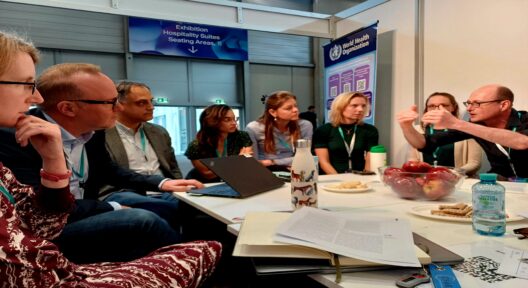
The project supports the coordination of the global WHO AMR CC Network and regional sub-networks through organising a webinar series, network meetings, and technical exchanges. It promotes the collaboration between partner institutions in WHO EURO and AFRO regions as well as enables s the development of sustainable partnerships.
-
Capacity building
The project strengthens national AMR surveillance systems through technical support and tool development. It improves data analysis and management capacities in partner institutions. Moreover, it supports the establishment of sustainable structures for AMR surveillance in the health sector. In doing so, it promotes regional expertise through a multiplier approach.
-
Training and competence development
AMR-EFFECT conducts regional train-the-trainer workshops on AMR and HAI data analysis for professionals from partner countries. For this purpose, it develops specific training materials, R scripts, and handbooks.
-
Policy support
The project provides technical advice for streamlining and implementing national AMR action plans usingdata-driven prioritisation. It supports German experts in international bodies such as the Global Leaders Group on AMR and the AMR Ambassador. The project develops policy briefs whereby surveillance data are transformed into concrete policy measures. It aligns national German and international AMR priorities.