PAcCIR
Public Health Actions for Côte d’Ivoire – Research
Context
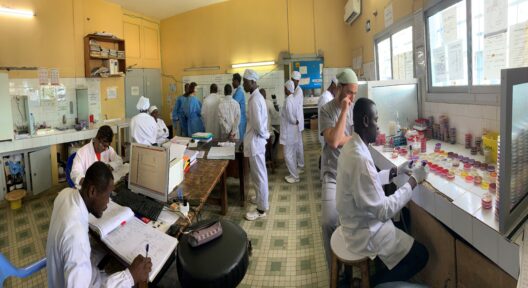
Pathogens with outbreak and zoonotic potential pose a significant threat to public health, particularly when antimicrobial resistance (AMR) further limits treatment options. In both cases, strong laboratory-based surveillance is essential, as its data can inform national health policies as well as infection prevention and outbreak control measures. Building on its predecessor project PAcCI, the PAcCIR project aims to strengthen public health capacities in Côte d’Ivoire, a country at increased risk of (zoonotic) outbreaks and AMR. Through long-term partnerships led by the Robert Koch Institute (RKI), PAcCIR integrates modern sequencing methods into research, diagnostics, and infection prevention. It also establishes the BSL-2 laboratory at the University Teaching Hospital in Bouaké (CHU de Bouaké), Côte d’Ivoire, as a regional training and sequencing hub. Next to CHU de Bouaké, the long-term partnerships also include the Helmholtz Institute for One Health in Greifswald, Germany and the Association Transformation for Development Institute in Bouaké, Côte d’Ivoire. The project comprises three work packages: strengthening laboratory capacities and One Health research, developing a regional AMR reference centre, and improving the prevention of surgical site infections. It also promotes regional knowledge exchange. A central component of PAcCIR is a structured M.Sc. research program. It combines applied research with intensive mentoring and soft skills training, thereby sustainably building expertise in the public health workforce.
Objective
Improved genomic and antimicrobial surveillance and infection prevention in Côte d’Ivoire
In Cooperation with
- Centre Hospitalier et Universitaire de Bouaké, Côte d’Ivoire
- Association Transformation for Development Institute (T4DI), Bouaké, Côte d’Ivoire
- Helmholtz Institute for One Health, Greifswald, Germany
Thematic priorities
Facts
Activities
-

Research and provision of evidence
The project advances infectious disease research, genomic surveillance, and One Health research. It also involves a study to improve the prevention of postoperative surgical site infections.
-
Networking and cooperation
PAcCIR expands the collaboration with the National AMR Coordinating Committee and aims to develop a regional AMR reference center. It also builds on the long-standing South–South collaboration with the GHPP project PASQUALE (Guinea–RKI), including annual exchange meetings on scientific methodologies, ongoing research, and analysis of preliminary results.
-
Capacity building
The project strengthens infection prevention and control programs through outreach activities, workshops, and training. It also establishes workflows for genomic surveillance.
-
Training and competence development
The project integrates a structured M.Sc. research program. It links all thematic work packages and includes intensive mentoring as well as soft skills training. The purpose is the sustainable development of public health professionals.