Empowering Infectious Disease Preparedness through Scientific Exchange
In 2025, four scientists from the Nigeria Centre for Disease Control and Prevention visited the Robert Koch Institute for a collaborative exchange with the NiCaDe team, strengthening skills in data analysis, joint research, and infectious disease response.
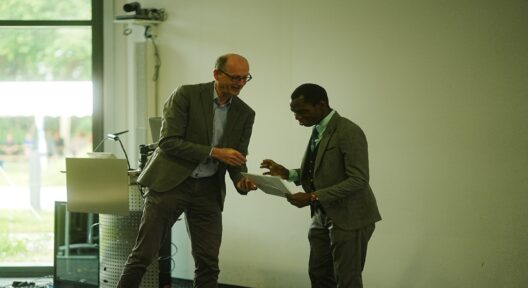
The project “Nigeria Centre for Disease Control: Capacity Development for Preparedness and Response for Infectious Diseases” (NiCaDe) is a longstanding collaboration between the Nigeria Centre for Disease Control and Prevention (NCDC) and the Robert Koch Institute (RKI) since 2019. During its second project phase, the RKI welcomed four co-scientists from the NCDC to Berlin on several occasions in 2025.
Dr Oluwaseun Odebajo visited RKI’s Unit 37 (Healthcare-associated Infections, Surveillance of Antibiotic Resistance and Consumption) from 25 May to 25 June. Focusing on antimicrobial resistance (AMR), the main goal of the exchange was to advance analytical and publication activities based on NiCaDe project findings. During the exchange, Dr Odebajo and the RKI’s NiCaDe-AMR and data scientists team at Unit 37 reviewed over 20 project reports, harmonised datasets, cleaned and analysed the data, and refined the intervention-outcome matrix. The team also standardised data extraction processes and reviewed supporting literature to inform the draft manuscript.

Dr Johnson Ojo (NCDC) underwent a research stay at Unit 15 (Viral Gastroenteritis and Hepatitis Pathogens and Enteroviruses) from 4 August to 24 October, with the goal to characterise hepatitis and gastroenteritis patient samples for circulating endemic viruses, including hepatitis B, C, D, E viruses, as well as rota- and noroviruses. Dr Johnson was trained in performing viral amplification using quantitative and qualitative methods and in analysing virus genotypes via phylogenetic analyses of sequencing data.
Chinedu Okoroafor and Jerome Dooga visited from 23 October to 4 November to work at the RKI’s ZIG office. During this time, the NiCaDe IPC team analysed monitoring and evaluation data, prepared presentations, and drafted manuscripts. Furthermore, the guest scientists presented evaluation results of the PALS IPC training and how the “Participatory Approach to Learning in Systems” engages communities in the ZIG Talk series on “Community-Led Approaches to Health Equity”.
Beyond advancing the scientific goals of the NiCaDe project, the exchange also strengthened institutional collaboration and enhanced technical capacity in data analysis, scientific writing, and interdisciplinary teamwork.
The visit was made possible through support from the RKI Centre for International Health Protection (ZIG) under the “Scientific Exchange Program” (RIO).