People, processes and partnerships – together for an Emergency Medical Team in the Federation of Bosnia and Herzegovina
When developing an Emergency Medical Team (EMT), it is the people who make up the team, the leadership and processes that back it up, and its partnerships, that all together bring progress into the EMT development journey. All the three aspects were present at the workshop held from 14 to 16 July in Sarajevo, which focused on developing an EMT in the Federation of Bosnia and Herzegovina (FBIH).
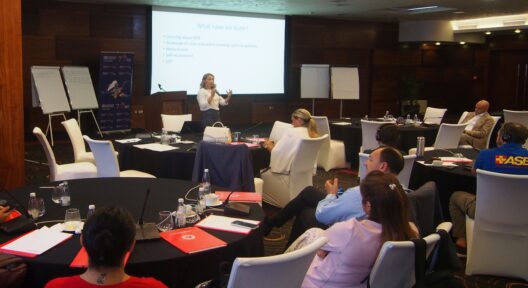
The workshop was implemented as part of the EMT Twinning collaborative approach of the GHPP project EMT ReCaP, together with two Robert Koch Institute (RKI) project partners: the German EMT Arbeiter-Samariter-Bund (ASB) and the Institute of Emergency Care of Sarajevo Canton. For the first time, the workshop brought together representatives from across the FBIH EMT structure and stakeholders’ landscape. This included the Ministry of Health of FBIH, the Civil Protection of Sarajevo Canton and Red Cross Society of FBIH as well as World Health Organization (WHO) country office as key actors in the process. The workshop was attended by three experts from the German EMT ASB in support of the peer-to-peer learning approach of Twinning, along with one member of the German EMT National Focal Point at RKI.
Diversity and energy were present from the first day. In one room, local medical staff, firefighters, mountain rescuers, and members of the Red Cross were introduced to the EMT Initiative of the WHO. They also learned the rationale behind establishing an EMT in FBIH as well as the progress achieved so far in the journey. ASB EMT experts also shared examples of their EMT journey as a WHO-classified EMT, particularly noting that FBIH EMT is currently undergoing the classification process.

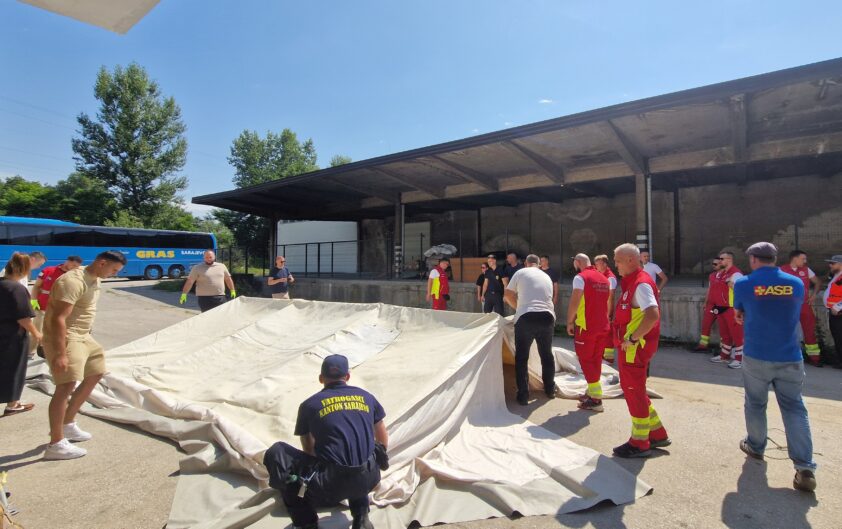
As hearing about something is better understood when discussed, seen and done, day two accommodated a hands-on visit to the Red Cross of FBIH warehouse in Visoko to showcase the existing capacities on which the EMT logistical capacities can be further built. Group discussions organised with the ASB team spread across the warehouse to brainstorm together the concept of EMT operationally and technically. Outside the warehouse and under the Visoko sun, a tent was set up and dismantled twice. It was an exercise in teamwork, illustrating how, independent of the job and the role that each team member has, medics and logisticians should work hand in hand as part of one EMT. Being inside the tent instead of a hotel venue inspired many operational questions and discussions around building up an EMT layout. The day ended with a visit to the Institute of Emergency Care of Sarajevo Canton. During this visit, the participants learned about its operational reality, characterised by a unique level of care that only exists in Sarajevo Canton at the level of the Federation of Bosnia and Herzegovina.
The last day provided an opportunity to jointly discuss the development process of EMT standard operating procedures, as well as to raise questions from the previous days and address foreseen challenges ahead, along with agreed next steps. By the end of the workshop, most participants who entered the room on the first day with limited information about the EMT initiative expressed enthusiasm and commitment on the last day to become part of the FBIH EMT development process. This was a key success moment in the workshop, providing greater clarity for the EMT managerial, technical and operational to-dos in the coming months – a process which the EMT Twinning collaboration of the GHPP project will accompany.

It might be possible to establish an EMT alone, but doing so in partnerships such as Twinning makes the process faster by integrating lessons learnt from others’ experiences and it supports mutual learning. It contributes to building an EMT community that is ready to collaborate in future responses when needed.