ViMOP: Bioinformatics behind Virus Surveillance – An Interview with Mia Le
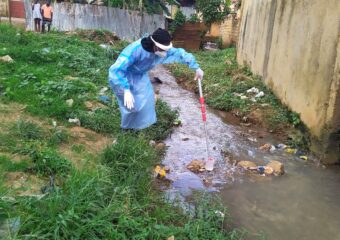
ViMOP is a Nanopore sequencing analysis pipeline used in sub-Saharan Africa for virus surveillance. Mia Le gives insights into the tool and the work as a bioinformatician.
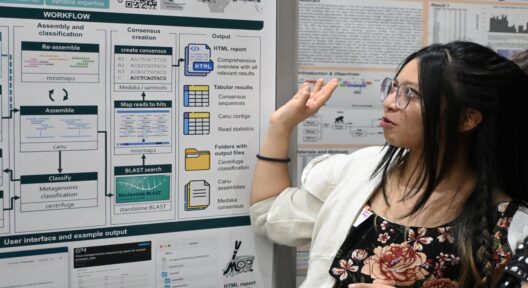
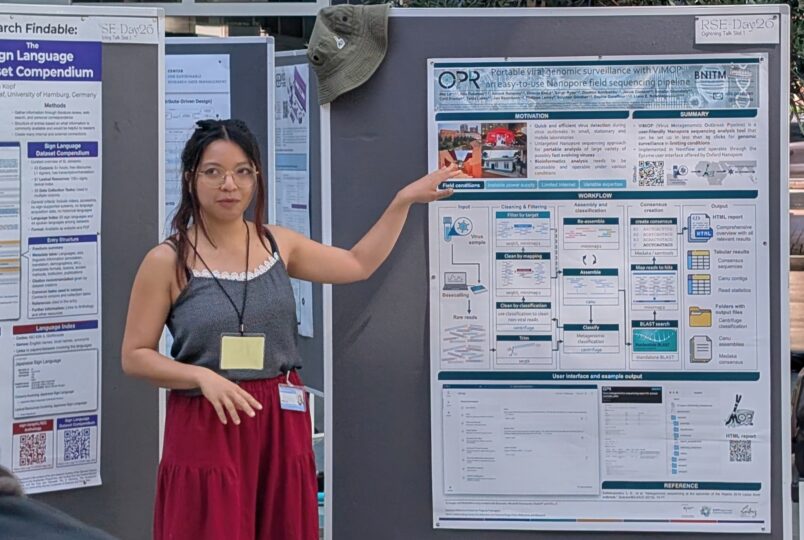
Since May 2025, partner laboratories in Guinea and Nigeria have been using ViMOP (Virus Metagenomics Outbreak Pipeline), a tool that turns raw nanopore data from untargeted sequencing into virus genomes.
The pipeline was published in the journal Bioinformatics in early 2026 and is freely available:
ViMOP: a user-friendly and field applicable pipeline for untargeted viral genome nanopore sequencing; doi:10.1093/bioinformatics/btaf687

What does ViMOP do?
When a lab sequences a sample without knowing which virus is in it, most of what it contains is not viral at all: human genetic material, bacteria and traces of lab reagents. ViMOP sorts through all of that and reconstructs the virus genome. It also handles viruses whose genome comes in several pieces and multiple viruses in one sample. Everything happens without typing a single command: one run, offline on a laptop. Our aim: A tool that simply works in the field.
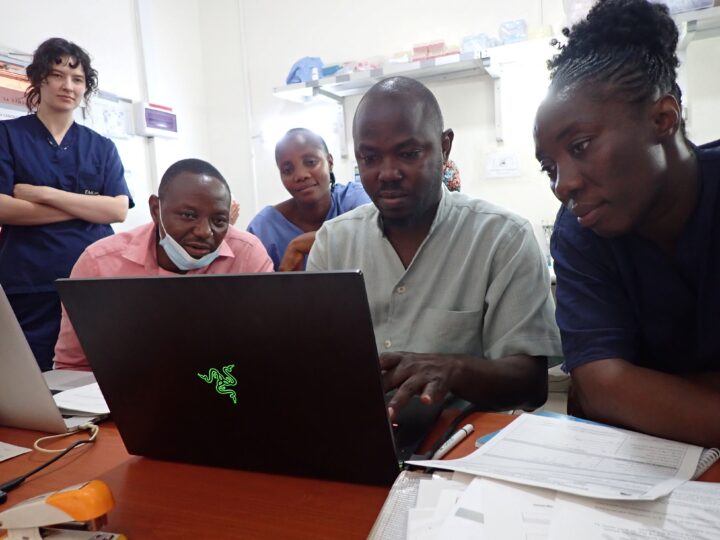
Dr Jacob Camara, Sequencing Team Lead at the Centre de Recherche en Virologie, Laboratoire des Fièvres Hémorragiques Virales de Guinée (CRV-LFHVG), said that the best part was that ViMOP worked without the command line and that the whole analysis ran with a few clicks.
What makes it stand out?
It still finds the virus when things get difficult: when it differs a lot from known genomes, or when only one in a thousand pieces of genetic material comes from it.
How did you achieve that?
Mostly through fine-tuning. ViMOP combines established tools that were originally made with different use cases in mind. Viral patient samples are noisy because we cover a wide range of RNA viruses. We spent weeks testing combinations on our data. In the end it is just a handful of settings, but they can be the deciding factor for whether we can reconstruct a viral genome properly.
Is the work done once ViMOP has produced a genome?
Actually, that is only the beginning of an analysis: By comparing genomes we can trace where an outbreak came from, and for reporting, we can share the genomes in public databases. But before that, the genomes have to be correct, so every gene is carefully checked and annotated.
How do you check them?
I wrote helper scripts that guide us through each genome, point out genes that look broken and show the raw data at that spot. A scientist then decides what the correct sequence is.
We recently used such genomes to reconstruct a hospital outbreak of Lassa fever in Conakry, Guinea. The infections could be traced back to one source (Nosocomial Outbreak of Lassa Fever in Conakry, Guinea, 2022; doi:10.1093/infdis/jiag229).
Can partner labs do this themselves?
Yes. I trained Dr Jacob Camara from the CRV-LFHVG partner lab in Conakry, Guinea, and Dr Ehizojie Emua, Chief of the Sequencing Laboratory at the Irrua Specialist Teaching Hospital (ISTH) in Nigeria, to analyse their own data. It is a good exercise too: To fix a gene you must understand the biology and how sequencing data behave.
What happens with the data after that?
We upload it to GenBank, one of the genome repositories where sequences are available worldwide. The data also come full circle: ViMOP’s reference library is built from public genomes, so today’s genomes help recognise the next outbreak.
What do you enjoy most about this work?
Working closely with the lab. ViMOP grew out of what our colleagues at the bench asked for, what they were missing and what kept going wrong. I am happy to see ViMOP being used and well received in the field. If problems arise, our partners have a direct line for technical support, and what they report shapes the next ViMOP version.
Dr Ehizojie Emua (ISTH), for example, said that he could start an analysis with just a few clicks and spend his time on what the results actually meant.